

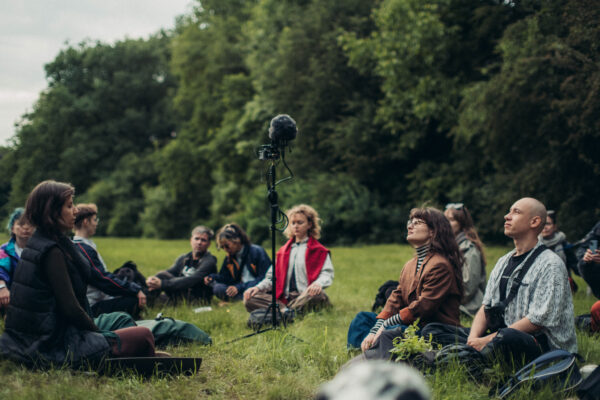


In sound art, it is the acoustic space that lends shape to what we hear; it becomes an instrument. Using sound, we can also shape the sense of that space, make it fluid, and subject it to constant transformation. When sound becomes a story, the narrative it contains constitutes yet another architectural layer that may be treated spacially.
The programme for the concert is based on three different attempts to score the narrative for the acoustic space. We posed the question of whether and how sound spatialisation techniques can be applied when working with a diverse understanding of a story? Can we treat the text as the space in which the composition is set, and can the particular listening point determine its reception and final form? Could we come to know a different version of the story told in the composition by setting the sound or the listeners in motion, changing places and angles of reception?
Each piece takes the form of an opera, a spatialised sonic story for performers, electronics, speakers and space. They are accompanied by listening scores – guidebooks to help navigate the multithreaded and spatialised sound construction.
When we become aware of the soundscape, we learn to appreciate the acoustic environment as a shared space. This awareness enhances our perception and understanding of the world around us.
Hildegard Westerkamp, Soundwalking (1974)
Maximiliano Bober
They/We listened: On the Becoming of Space (2024)
Spatialised Post-opera
Post-dramatic chamber piece for vocals, portative organ, electric guitar, violin and audience. Audience participation is indicated by a score based on selected literary excerpts. The underlying concept of the composition is sound as a slowly evolving element that structures the collective space. Słuchałośmy (they/we listened) is an untranslatable but audible word (the inspiration comes from a word used by Ada Adu Rączka in their poetry). We understand sound directly, in its ambiguity and multitextuality. The piece offers an experience of language and sound as shared and accessible to all, where silence becomes a mediator between individual and collective experience. The process of listening is closely linked to reading. The word activates the voice, the voice evokes the sound, the sound creates the space. The text becomes a score and a guide to the composition and its transient, ephemeral sound space. The work’s polyphony is an open system, an invitation to experience the space from multiple points, to observe its transformations, to immerse oneself in the acousmatic fabric of the story that unfolds in the process.
Literary excerpts used:
Gonçalo M. Tavares – Encyklopedia. Notatki, translated by Wojciech Charchalis, słowo obraz/terytoria (2018)
Anna Świrszczyńska (1909-1984) – Jestem Baba, Prószyński i S-ka, (2000) and
Budowałam barykadę (published in 1984 to mark the 40th anniversary of the Warsaw Uprising)
Ada Adu Rączka – Chciałośmy, SDK, 2022 and spółdziel lub nie, 2022
Notatki i Flores ensemble:
Maximiliano Bober – violin
Ryszard Lubieniecki – portative organ
Michał Sember – guitar
Małgorzata Wrzosek – vocals
Alina Dzięcioł
Processes in Four Phases
for electronics (2024)
The main idea behind the composition is the multidimensional representation of distortion processes occurring at different levels of listening perception and reasoning. The employed means include delicate colour-dynamic transformations, distribution of sounds in space (constructed differently in each phase), listening exercises opening up the interpretative field. The piece consists of four parts, individually approaching their content with sound in a highly intuitive way.
Phase I Earth – at first it appears as a quiet imitation of the sounds of nature or the surroundings, but what will their gradual tonal transformations result in? While the initial source of sound will consist of what we can actually hear in everyday life, will we retain a sense of being in a familiar and ‘safe’ reality?
Phase II Disasters – takes the listener into a slightly less ‘safe’ reality, as its title suggests. What makes the surrounding nuclear sound so “dangerous” is that after a sudden explosion occurs, we can get a bit spooked, especially since we don’t know if there will be another one, and if so, when and what it will turn into…
Phase III Ayahuasca – the process begins with the reflection of a human individual, a quiet, contemplative narrative. What conclusions will they reach after what has happened in the previous phases? For some reason, they will decide to partake in the Ayahuasca ritual, which will open a door leading to the subsequent reality!
Although the narrative of the first three phases provides a similar ‘general’ scheme for presenting the process of distortion – the appearance of sound entities that are subjected to distortion increasing the density of their sound, the opposite is true for the arrangement of the phases in this particular order – from totality to the individual human entity.
Phase IV Sparkling – represents the most abstract section with regard to its narrative construction method. The sound events wandering in space seem to form a collage of disordered events from the previous phases. However, they too are part of a certain process.
Simi Fyda
In My Personal Heaven, I’m the Devil’s Spawn (2024)
An octophonic piece exploring the artist’s personal experience of reading the works of Deleuze and Guattari. Each of the eight sound tracks represents key concepts of their philosophy, creating an immersive sound experience. The project brings together elements of reflections on desire, the body and drive.
The composition represents fragmented networks, transitions between chaos and control-imposing structures, mechanical and organic rhythms, irregular sound spaces, field recordings, chaotic sequences and contrasting elements.
With regard to the philosophical context, the piece is a reflection on masochism, which Deleuze conceives as a tool of subversion and creation. Masochistic experience challenges established structures of power and identity, becoming a creative act that explores the limits of desire and identity. Masochism is not a negative experience of pain, but an affirmative process of sublimation in which suffering becomes an aesthetic quality.
The sound and narrative layers of the piece represent a contemplation on the unity of being, emphasising non-hierarchical, multidirectional thought networks as well as a productive and creative approach to desire.
About the artists
Maximiliano Bober
Composer, improviser and sound artist born in Argentinian Patagonia. His work explores the relationships between translation, orality, writing, and sound art. Focusing on the relations between sound and literature, he aims to establish spaces of solidarity and friendship founded on listening. He has collaborated with, among others, Kyiv Music Fest, Ad Libitum, the 64th Warsaw Autumn Festival, the 53rd International Festival of Contemporary Music “Poznań Music Spring, Wandelweiser Klangraum (Dusseldorf), Atemporanea (Buenos Aires). In 2022 he founded the chamber group Ensemble del Cerro, and in 2023 the Rumiarec label released his album Cantos a Nenette performed at the Musica Privata XI festival. In 2024, the Sello Postal label released his sound art work about the Warsaw underground Metro 1: Kabaty-Młociny. Since 2017, he has been living and working in Warsaw.
https://maxbober.bandcamp.com/
Alina Dzięcioł
Student of composition at the Karol Lipiński Academy of Music in Wrocław under Prof. Dr. Agata Zubel. Graduate of the Fryderyk Chopin University of Music in Warsaw in accordion, recipient of a scholarship from the Młoda Polska 2018 Programme for artistic achievements. In her compositions, she likes to combine dry, purely mechanical sounds with emotionally charged layers. She often draws inspiration from psychology literature. Her works have been awarded, among others, in the 62nd Tadeusz Baird Young Composers Competition and the Matan Givol International Composers Competition 2022. She has participated in many composition courses, including the Akademie für Neue Musik (PER-FORM) in 2022. Her works have been performed at such festivals as the Warsaw Autumn, Musica Electronica Nova, On the Road to a New Harmony, as well as in France, Spain, Italy and Switzerland.
https://youtube.com/@alinadziecio3205
Simi Fyda
Simi Fyda(Simona Fyda) is an experimental artist who explores her connections with ancestors, femininity, tradition, and change in an audio-visual manner. In her sonic performances, she not only emphasizes sound, but also delves into aesthetic and narrative aspects. Last year, she released her debut album “Yuri” (post-industrial, dark ambient, deconstructed club), consisting of seven collage compositions that combine cyber-mystical sounds with field recordings.
https://enjoylife.bandcamp.com/album/yuri
Ryszard Lubieniecki
Composer, musicologist, instrumentalist, improviser. He studied composition and accordion at the Academy of Music in Bydgoszcz. In 2023, he completed his doctoral thesis under the supervision of Professor Remigiusz Pośpiech at the Institute of Musicology in Wrocław (where he currently works as an assistant professor), on memory and its traces in late medieval musical and theoretical sources from the Central European region. In addition to the accordion, he also plays medieval keyboard instruments (portative organ and clavicymbalum). Co-founder of the contemporary music trio Layers and the medieval music ensemble Vox Imaginaria, as well as more ephemeral improvised music groups, including Izquierdo/Lubieniecki, Widzicie, Lubieniecki/Rupniewski and Disquiet.
https://soundcloud.com/ryszard-lubieniecki
Michał Sember
Born in Środa Śląska, he lives in Wrocław. He has been playing improvised music in various lineups for over a decade. He usually uses electric guitar, objects and voice. He has had the opportunity to collaborate with artists such as Paulina Owczarek, Agusti Fernandez, Michał Biel, Adam Webster, Mateusz Rybicki, Paweł Doskocz, as well as musicians from the Dźwięk-Bud collective in Łódź. He is a member of the music editorial board of Academic Radio LUZ, where he hosts the author’s Tembr program on experimental music. As a Siemper he participates in rap freestyle battles and as a repmeis he plays DJ sets and produces computer songs.
Małgorzata Wrzosek
Vocalist, visual artist and performer. Currently lives and works in Wrocław. Her musical education background is rooted in traditional music, sacred music and free jazz. She explores the potential of the human voice, seeking its beauty and dirt. She contributes to the improvised music scene in Poland and as UKOJENIE collective runs a podcast on the independent Radio Kapitał. A member of DOGONI, De Pedregal, Warsaw Improvisers Orchestra, Sound in Space Orchestra, POKUSA XXL, and Voice LAB. She has collaborated with, among others, Aleksander Żurowski, ASTMA, Raphael Rogiński, and Edka Jarząb.
https://magorzatawrzosek.bandcamp.com/
THE EVENT
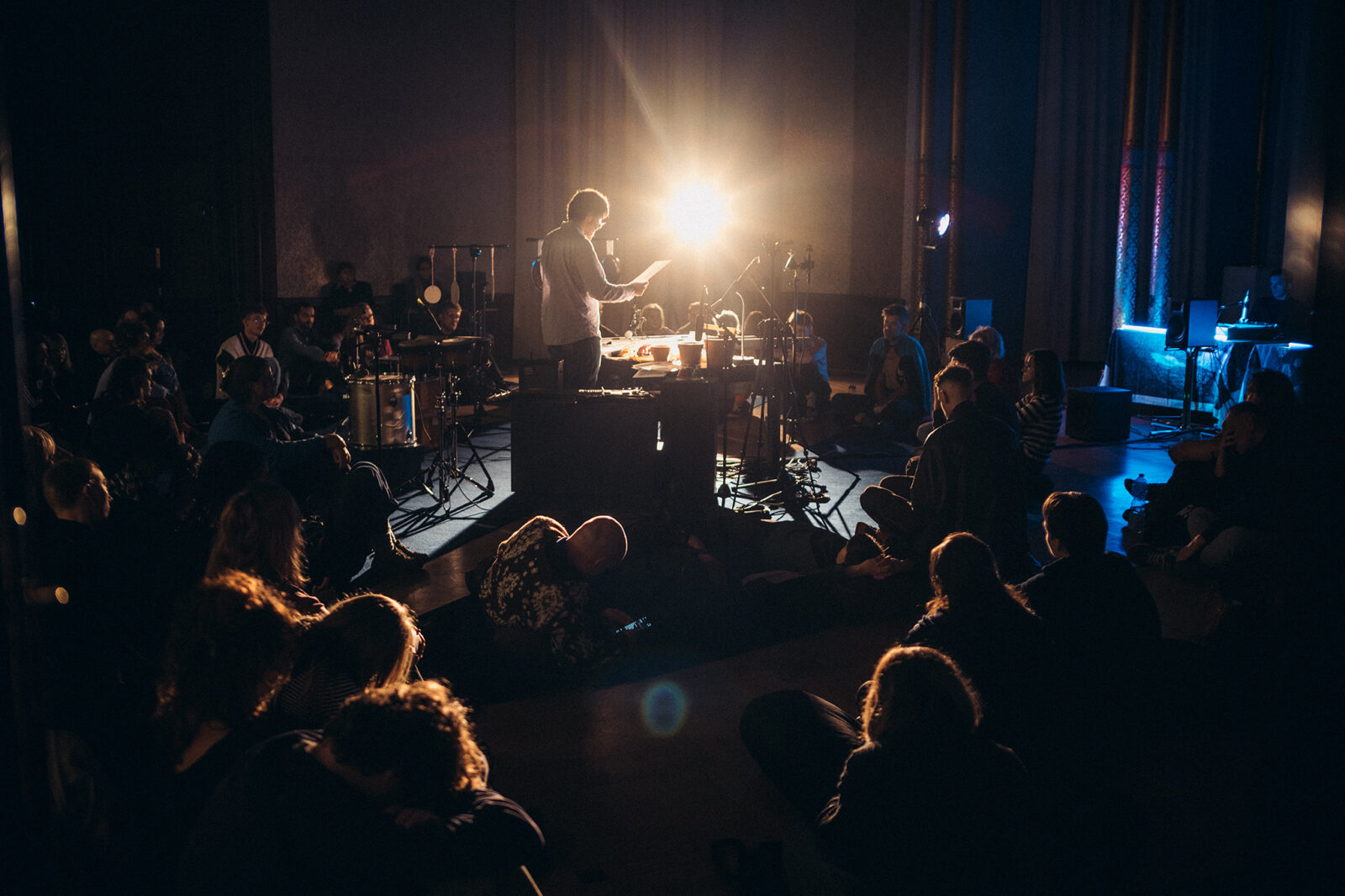
The concert took place on 19.10.2024 at the BWA Wrocław Główny Gallery.


The team
Daniel Brożek (curator), Marta Konieczna (producer, PR,co-curator)
Visual identity: Karolina Pietrzyk + Gilbert Schneider
Organiser: Fundacja na Rzecz Studiów Europejskich
Partners: BWA Wrocław Galerie Sztuki Współczesnej
Media patron: Glissando
Series co-financed by the City of Wrocław | www.wroclaw.pl and under the funds of the National Recovery and Resilience Plan: a program to support the activities of cultural and creative industries entities to stimulate their development.


