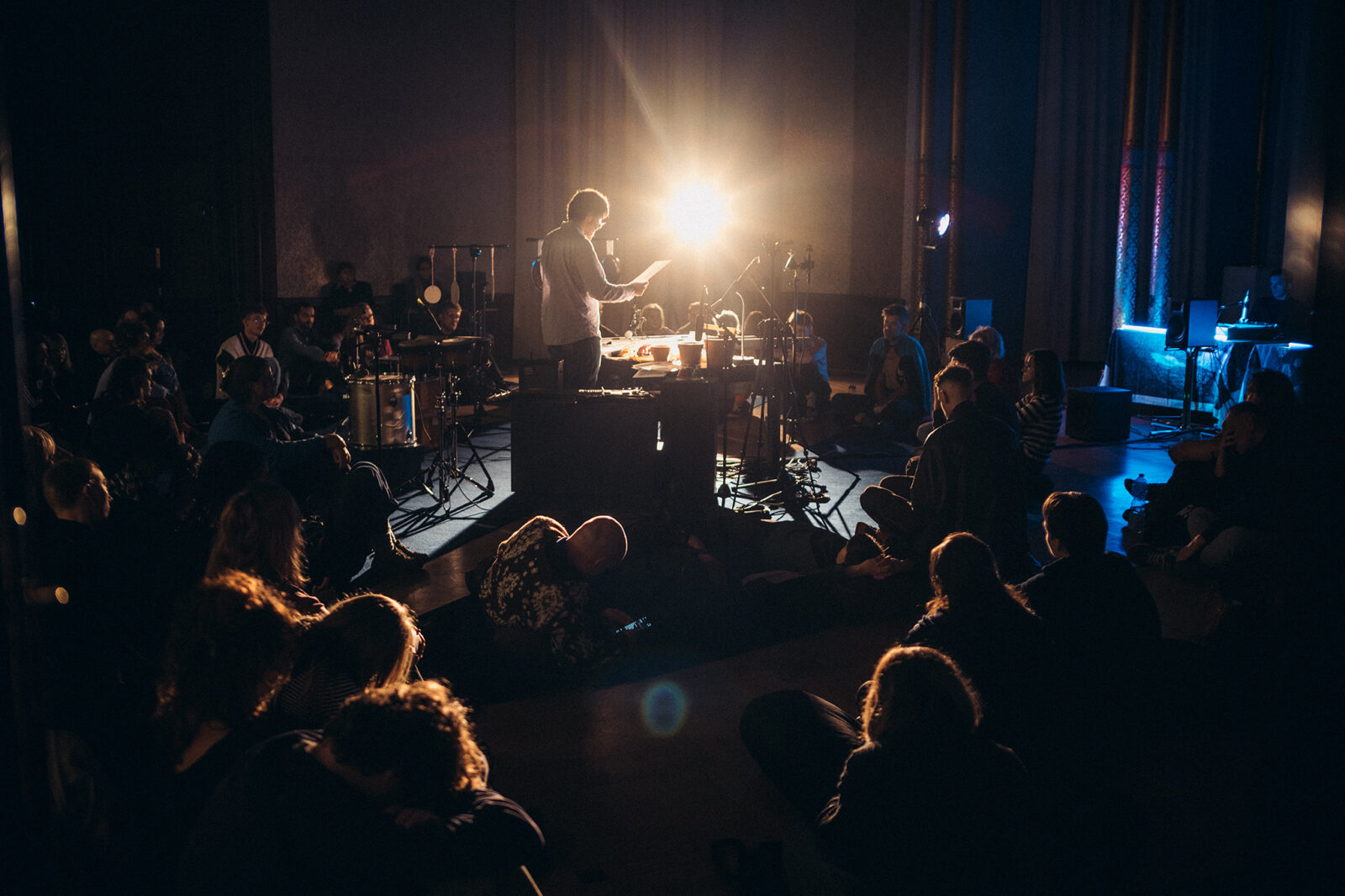


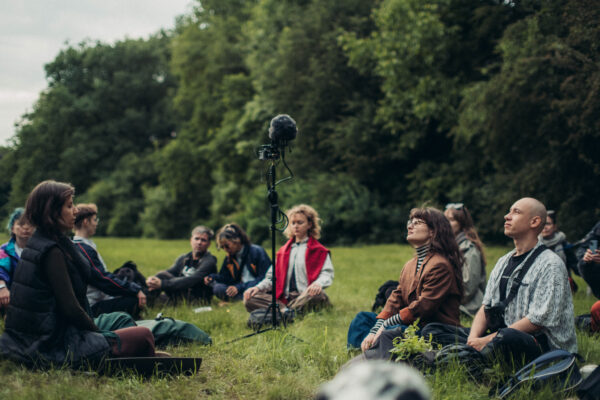


Canti Spazializzati for the first time as two days of concerts! An expanded, rich and, of course, spacialized program, already on the weekend of October 11-12 in the “Sala Sesyjna” (Session Hall) of BWA Wrocław Główny.
This year’s program of the Canti Spazializzati series moves in a spiral in its explorations. More precisely, it follows the concept of an open spiral form popularized in the 1960s and 1970s by Leoncjusz Ciuciura.
A snail, a whirlpool, DNA, a galaxy. The spiral form swirls around us in the world and within ourselves. There was a composer in Poland who was fascinated by it, his name was Leoncjusz Ciuciura. He died in 2017 and today he is perhaps a somewhat forgotten artist, but he left behind an extraordinary, enigmatic, and certainly avant-garde legacy. Why was he so intrigued by the spiral?
“In my compositions, there is no division into performers and the audience: there is only a homo creator, the sensitized man co-experiencing the world syntonically, imaginative, with an open mind, sensitive to new intellectual-aesthetic experiences, a man with the ability to accommodate. It has always been clear to me that in order to accomplish such programme objectives, a new form must be developed. The spiral form is – in my view – most adequate, because its fundamental feature is the dynamic integrating tendency of all its elements towards internal unity, cohesion and substantial perfection.”
Following in Ciuciura’s footsteps, along the spiral path of his fascination, we have put together this year’s programme for the 21st edition of the Canti Spazializzati concert series. The starting point was the composition Spirale I per uno and the desire to perform it by Ryszard Lubieniecki and Michał Sember, a duo well known to our series. This was an extraordinary performance, as it was the first time that this composition, written in 1964, had been performed based directly on Ciuciura’s ideas and notes. So it started with Spirale, and then everything somehow set itself in motion and spun… As a result, here is the programme for the double concert Canti Spazializzati #21: Spiral Form:
SATURDAY, 11th of OCTOBER
Leoncjusz Ciuciura – Spirale I per uno (1964→)
Ryszard Lubieniecki – Spirale della memoria (2025) * na clavisimbalum, instrumenty perkusyjne i elektronikę
Miłosz Kędra – our breath, recurring, our breath (2025) *
Leonie Strecker – peripher (2025) *
SUNDAY, 12th of OCTOBER
Katarzyna Podpora – )personal) movements((() (2025)*
Mikołaj Szmeichel aka Lemta Toro – Zdanie z pewnego snu: (2025)*
Oktawia Pączkowska – Vortex (2025)*
* first performans, commissioned by Canti Spazializzati
ABOUT THE ARTISTS
Michał Sember
Born in Środa Śląska, he lives in Wrocław. He has been playing improvised music in various lineups for over a decade. He usually uses electric guitar, objects and voice. He has had the opportunity to collaborate with artists such as Paulina Owczarek, Agusti Fernandez, Michał Biel, Adam Webster, Mateusz Rybicki, Paweł Doskocz, as well as musicians from the Dźwięk-Bud collective in Łódź. He is a member of the music editorial board of Academic Radio LUZ, where he hosts the author’s Tembr program on experimental music. As a Siemper he participates in rap freestyle battles and as a repmeis he plays DJ sets and produces computer songs.
No bio found for the given ID.
Miłosz Kędra
The compositions of Miłosz Kędra (2001) explore synthetic sound, electroacoustic and acoustic instruments, seeking different timbres, tunings and textures. Their main field of work, and the centerpiece of their first album For Aeons (2021), is the pipe organ. In this work, through minimalistic themes, he transports the sounds of the instrument outside the church by synthetically processing its tones. Currently, they are studying for a Master’s degree in New Media Music at the Academy of Music in Poznań and recently completed their Bachelor’s degree in Electroacoustic Composition during which they built their own pipe organ. Their latest album “their internal diapasons” has garnered attention across European and international experimental music circles, praised for its imaginative reinvention of the pipe organ and its raw, textural approach to sound.
Amazona Assem
(b. 1998, Cairo) In her works, she seeks to deconstruct hierarchies of individual and collective oppression, as well as reformulate analogies and symbolisms through abstract representations. She delves into topics of selfhood/personhood, bio-editing and hacking. She is interested in issues of philosophy. queer prosecution and migration in the global south and adaptation and survival tactics in the exile, indigenous practices and rituals. She expresses her takes through mediums of performance, video-art, sculpture and spoken word of mouth and aims to broaden the mediums through which her ideas manifest.
Leonie Strecker
Leonie Strecker is a composer and sound artist. Her work includes electronic and electro-acoustic music, compositions for soloists and ensembles, as well as performances and installations. She explores ideas around the hybridity of form, presence and absence, the connection of memory and experience, and the meaning of concrete and synthetic sound. Her works have been shown at La Biennale di Venezia, Venice; Audio Art Festival, Krakow; Musikprotokoll Festival, Graz; Kunstpalast, Düsseldorf; Kunstsammlung NRW, Düsseldorf; De Singel Arts Centre, Antwerp; ZKM, Karlsruhe, among others. Born in 1995 in Düsseldorf, she studied electroacoustic composition in Rome and Düsseldorf before graduating cum laude from the University of Music and Performing Arts in Graz. She is currently based in Vienna.
Katarzyna Podpora
Multimedia artist and translator based in Gdańsk, bonded with the sea – its audiosphere, flux, influence on matter; she’s active in the field of sound, visual and textual art, and holds a PhD in Sculpture and Intermedia Art. Her creative work revolves around material and individual qualities of beings (both living and non-living), performative and ephemeral aspects of form, as well as the issues of process and memory in the context of recordings made by means of various media – audio, video, photography. She focuses on listening to materials and spaces. While creating experimental music (e.g. in the PODPORA/KOHYT duo https://podporakohyt.bandcamp.com ), she highlights the role of her instrumentarium which consists of objects considered trash, including dead remains of non-human beings – animal bones, dead parts of plants, as well as dilapidated instruments, destroyed gramophone records and tapes with field recordings. Her artworks have been presented at many exhibitions as well as festivals of contemporary art and music.
Mikołaj Szmeichel
AKA Lemta Toro. Author of the 2021 album True Religion, on which they experimented with cassette loops and field recordings. In 2023, they released ‘KAPITAŁKA’, combining raw, synthesizer soundscapes with white singing. Their music draws inspiration from low-fidelity sensitivity, tape music, and folk music. Their tracks have been featured in mixes on Noods Radio, LYL Radio, Culture.pl, as well as on lists by The Quietus and 4AD.
Oktawia Pączkowska
Composer and sound artist. Her works have been performed in Poland and abroad at festivals such as Setkávání Nové Hudby Plus in Brno (Czech Republic, 2017), Tehran Contemporary Music Festival (Iran, 2018), New Music Days in Lucerne (Switzerland, 2018), New York City Electroacoustic Music Festival (USA, 2021), HELMCA Electroacoustic Music Days (Greece, 2021), Lampi Di Rete Audiovisual Marathon (Italy, 2022), Audio Art in Krakow (2022, 2024), MUSICACOUSTICA-HANGZHOU (2023), Warsaw Autumn (2023, 2024) and ManiFeste Festival in Paris (2025).
Winner of such competitions as the Keiko Yoneda International Composers’ Competition (2021) and Composition Competition of the 10th International Competition of Duos with Harp (2024), as well as a three-time finalist of the PRIX CIME International Electroacoustic Music Competition (2019, 2021, 2023). She has participated in international residencies and programmes, including composer.pl (2021), JACK Studio (2023) and One Beat Virtual #5 (2024).
She is a recipient of the Minister of Culture and National Heritage Scholarship (2020), the Creative Scholarship of the City of Krakow (2023), and the Young Poland Scholarship (2024). Paczkowska earned her Master’s degree in 2021 from the Krzysztof Penderecki Academy of Music in Kraków. She graduated with a master’s degree from the Karol Penderecki Academy of Music in Krakow and studied at the Lucerne University of Applied Sciences and Arts as part of the Swiss-European Mobility Programme (2018). She is currently pursuing a PhD at the Fryderyk Chopin University of Music in Warsaw.
THE TEAM
Daniel Brożek (curator), Barbara Celebucka (producer), Marta Konieczna (PR)
Visual identity: Karolina Pietrzyk + Mateusz Zieleniewski
Organiser: Foundation for European Studies
Partner: BWA Wrocław Galleries of Contemporary Art
Media sponsor: Glissando
Series co-financed by the City of Wrocław and as part of the National Recovery and Resilience Plan: programme supporting the operation of the cultural entities sector and creative industries to stimulate their development.


