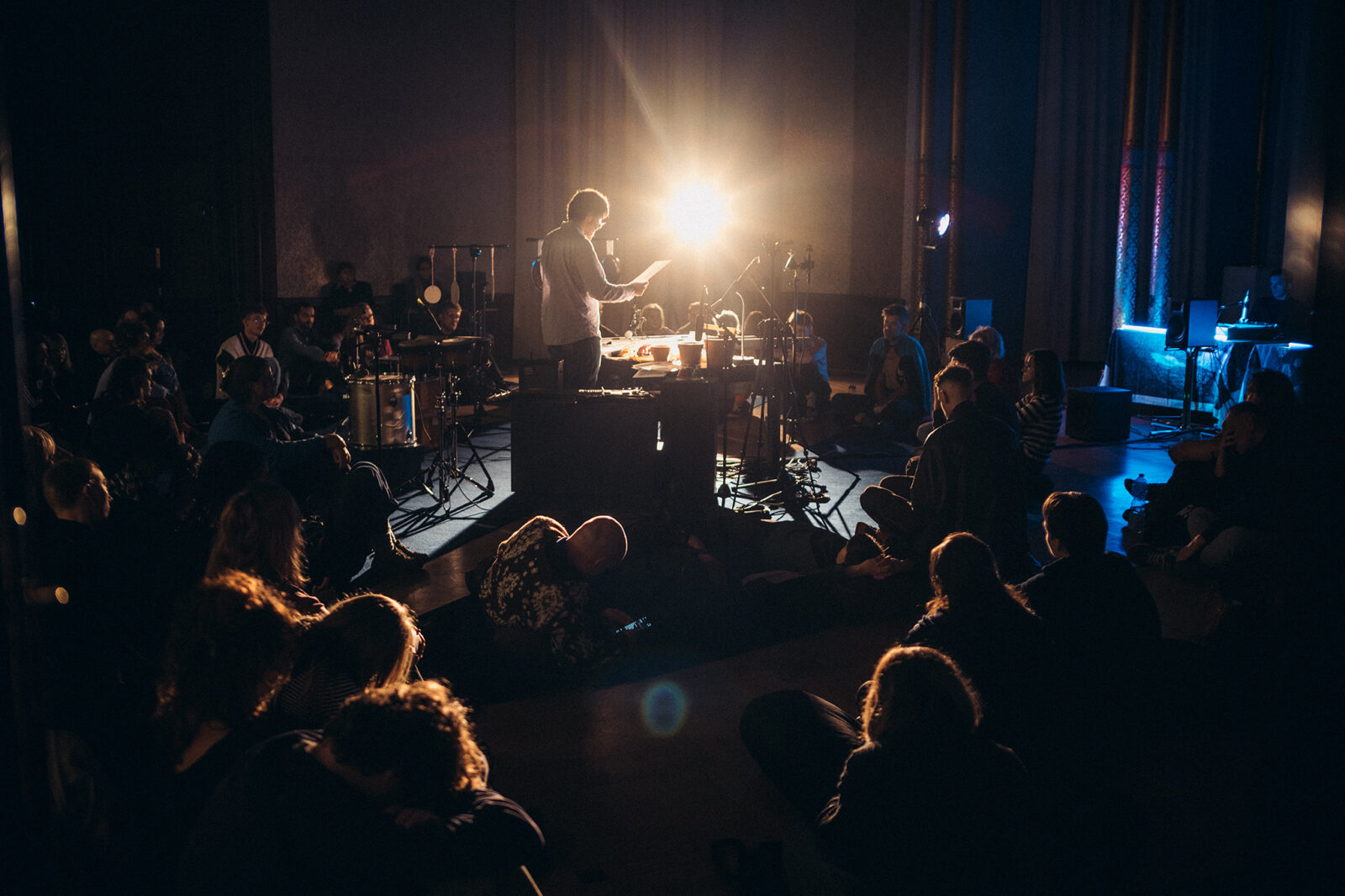


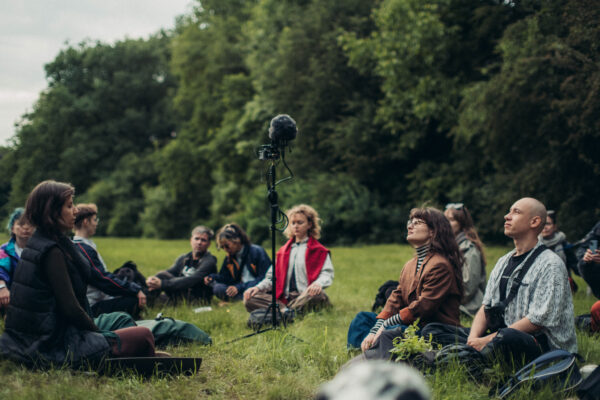


In the pandemic year of 2020, our presentations of multi-channel experimental music will take place in a modified format. Together with the Dizajn BWA Wrocław gallery, we have prepared a sound system and a program of acousmatic sound projections called Radio Żyjnia in the urban social spa space. They will take place daily in two one-hour slots (12:00 and 5:00 p.m.). Due to sanitary restrictions, only 6 people can be in the gallery at a time, and the program will change every month. Radio Żyjnia is not only a sound space formula for the urban sanatorium. In the pieces we have selected, we try to address issues inherent in the nature of this place, such as deep adaptation and artistic practices in the era of climate crisis, related ideas of deep listening, ecology, and soundscape. The program will include premiere compositions, prepared especially at our invitation, as well as pieces reflecting the state of the present day, expanded for our sound system. We also continue to present compositions from the canon of the tradition of spatial sound experimentation. Some of the works we present are also attempts at sound creation based on Jerzy Rosołowicz’s vision of Neutrdrom – a space for neutral activities, deliberately avoiding narrative, meaning, and intentionality in favor of work in process, close to nature and the idea of the coexistence of all beings, born out of the self-awareness of the proximity of self-destruction. Created in 1967, this work is one of the few examples of Polish conceptual art referring to sound phenomena. The presentations of these works are part of the Wrocław 70/20 Symposium, a grassroots program celebrating the 50th anniversary of the Wrocław ’70 Art Symposium.
Canti Spazializzati x Radio Żyjnia #1
Beniamin Głuszek, Bartek Kujawski, Marta Śniady, Pauline Oliveros
PROGRAMME:
Bartek Kujawski
Psychomachia (quadraphonic mix) (2020) / 30:01
This postmodern sound sculpture in stereo was developed in 2018, produced in 2019, and released on cassette in 2020 by Pointless Geometry. Acoustic instruments and electronic devices were recorded in various locations, such as the Wiaczyń nature reserve, an abandoned canal in Łódź, a wooden latrine in the village of Strzałki, and many others. The quadraphonic version of the material presented here, prepared at the invitation of Canti Spazializzati, is based on recordings made for the cassette, but it is a new mix that differs in many respects.
Marta Śniady
Ore (2015) for two tibetan bowls and gong / 4:44
Performer: Leszek Lorent
ore – a naturally occurring material from which metal or valuable minerals can be extracted in a cost-effective manner. The piece is a study of the sound possibilities of metal on a micro scale. By modifying the pressure, angle of incidence, and friction speed of two Tibetan bowls and a gong, the performer explores the color spectrum of metal surfaces.
Pauline Oliveros
Sayonara Sirenade 20/21 (1966/200) / 4:26
In 2000, at the invitation of Starkland, Pauline Oliveros prepared a multi-channel piece based on recordings made in 1966 at the San Francisco Tape Music Center. During that period, Oliveros composed, among others, “Bye Bye Butterfly” and “Big Mother Is Watching You,” which have become permanent fixtures in the canon of electronic music. Shortly thereafter, as a result of political events (the Vietnam War, the assassination of Kennedy), Pauline abandoned her career as a composer for many years in favor of developing the practice of deep listening. “Sayonara Sirenade 20/21” was her first attempt at creating a spatial composition based on synthetic sounds. We present its 4-channel version.
Beniamin Głuszek
Fale neutralne (2020)
This five-channel piece devoted to the translation of human brain waves (EEG) into sound is part of a series of compositions and workshop activities related to Jerzy Rosłowicz’s concept of Neutrdrom. Many processes in the human brain occur beyond our intentions and consciousness. The rhythmic patterns and textures created by brain waves recorded by an electroencephalograph form the basis of the compositional process that takes place between the listener’s subconscious and the acoustic response of the space.
ABOUT THE ARTISTS:
Beniamin Głuszek
Creator of sound installations, music theorist. The main subject of his interest is the sonification of the electrical activity of the human brain (EEG). He has presented his works in the Czech Republic, the Netherlands, Scotland and Poland – including at the “Warsaw Autumn” and “AudioArt” festivals, during the Art Review “Survival”.
https://www.polskieradio.pl/8/2565/Artykul/2030150,Fale-mozgowe-w-sztuce-i-medycynie?
Bartek Kujawski
He is a musician who has been active in the Polish experimental independent scene for many years. In the past he has released several albums under the pseudonym 8rolek, mainly on the Mik.Musik label, but also on several others, and has played at festivals around the world (including Club Trasmediale DE, Vien Modern AT, Skiff RU, Unsound PL). For several years he has been publishing under his own name and playing in the duo TSVEY with Piotr Poloz.
Pauline Oliveros
(1932-2016) – American composer and accordionist, heroine of the post-war musical avant-garde, author of the philosophy and practice of deep listening, one of the founders of the first American research center dedicated to experimental music (San Francisco Tape Music Center), lecturer at the legendary Mills College.
http://deeplistening.org/
Marta Śniady
Composer of audio-visual works. She draws from popular culture, the Internet and Television. She does not treat her music only as sound art, but seeks multi-layered meanings, references, connections. Her works have been presented during: Warsaw Autumn, Musica Electronica Nova, Frau Musica (Nova), Sacrum Profanum, Pulsar, Klang, RAMA, Musica Estranha and Percussion Plus.
EVENT
Canti Spazializzati x Radio Żyjnia #2: Piotr Bednarczyk / Michał J. Biel / Aleksandra Słyż / Krzysztof Knittel / Beniamin Głuszek
PROGRAMME:
Aleksandra Słyż
Iridescence (2020) *, 10’10”
Iridescence – an optical phenomenon also known as rainbow effect; related to the presence and behavior of light, which changes its quality with a change in perspective. It is often caused by the reflection of a light beam from a transparent or translucent surface and its modulation, thus amplifying or attenuating some of its frequencies. The multi-channel composition Iridescence is an auditory interpretation of the perception of this optical phenomenon.
Michał J. Biel
Zapośredniczanie (2020) * from Default Logic series, 20′
Cosimo Fiaschi – soprano saxophone M. Biel – baritone saxophone
The piece is a reflection on the musicality of field recordings. It stems from my attempts to integrate acoustic instruments with overheard sound environments. At the same time, I focus on memory, and it is memory that comes to the fore in the new formula prepared for Radio Żyjnia. Anamnesis, Remanence, and Phonomnesis – concepts taken from the idea of “Sonic effects,” which aims to understand and describe phenomena occurring in sound environments (mainly urbanized ones) – were the original assumptions of the composition for me.
The Default Logic series is an attempt to address the issue of perception and the complexity of the processes that
constitute it.
Piotr Bednarczyk
blended (2020) *, 7’28”
The quadraphonic composition is based on sampling techniques of delicate noise structures recorded from a close perspective and simple synthetic sounds that freely interpenetrate in space. The interactive modeling used in the composition process was developed for a series of workshops referring to Jerzy Rosłowicz’s Neutrdrom concept.
Krzysztof Knittel
norcet II(1980), quadrophonic version, 16’26”
Computer music on tape produced at the Computer Studio of the State University of New York in Buffalo (1978) and at the Experimental Studio of Polish Radio (1980). The title comes from the words natural-objects-recording-computer-electronics-tape. The composition premiered during the Warsaw Autumn Festival in 1980. In Wrocław, it was presented during the Polish Contemporary Music Festival (1984, at the Museum of Architecture) and the Macrophon International Radio Art Forum (1991; during this festival in 1994, Krzysztof Knittel’s interactive installations were also presented at BWA Dizajn).
In the program for the premiere concert, the composer wrote the following about the piece (from the book accompanying the album Knittel/Sikora/Michniewski “Secret Poems” published by Bołt Records):
I spent the spring and summer of 1978 in Buffalo. I lived in a quiet, secluded neighborhood in the attic of a large wooden house. My host was a psychiatrist who saw patients at home. The house was always quiet and a little eerie – perhaps that is why I liked the place and its atmosphere. When it was warm, I often sat upstairs by the open window and listened to the sounds coming from the street – the quiet rustling of trees, the occasional passing car, the distant sirens of ambulances. When I was writing, the old folding table would creak: I would sometimes mumble to myself, not words, not a melody, just a low, humming sound, something like that… Actually, these were all noises and sounds that we don’t pay any attention to, treating them as silence. One day, I decided to record and enter this resonant silence into my computer […]
As in concrete music, the source material for the piece is natural sounds. The method of transformation also derives from traditional tape music – it is a feedback loop obtained on a small PDP-8 computer by John Morley, who was in charge of the studio’s digital equipment at the time. The mixing program we used was written for the same computer a year earlier by Giuseppe Engler. The entire recording took only three or four hours. Then, for several weeks, I edited the tapes with the sounds recorded using this method, arranged them into five layers of composition, processed some of them further on electronic devices – filters, ring modulators, used voltage control, reverb and similar transformations, but I still didn’t have a clear picture of the whole and stopped working. I returned to this material after a two-year break, only at the Experimental Studio in Warsaw. The piece has several versions. There are two tapes – one with sounds obtained from a computer (norcet 1) and the other in which the same sounds are combined with natural effects, but different from the material recorded in Buffalo. […] The voice appearing in the second version belongs to John Morley, who talks about the sound transformation we used through digital coupling.
Beniamin Głuszek
Fale neutralne (2020), interactive installation
This five-channel piece devoted to the translation of human brain waves (EEG) into sound is part of a series of compositions and workshop activities related to Jerzy Rosłowicz’s concept of Neutrdrom. Many processes in the human brain occur beyond our intentions and consciousness. The rhythmic patterns and textures created by brain waves recorded by an electroencephalograph form the basis of the compositional process that takes place between the listener’s subconscious and the acoustic response of the space.
ABOUT THE ARTISTS:
Piotr Bednarczyk
He was born in 1994 in Koszalin. He is currently studying composition under Cezary Duchnowski at the Karol Lipinski Academy of Music in Wroclaw. His works have been performed at contemporary music festivals such as Warsaw Autumn, Musica Electronica Nova, Listening Room and New Music Week. As a composer, he focuses mainly on electroacoustic music, with a strong focus on the search for new sounds, through which he uses unconventional sound production techniques and live electronics.
Michał J. Biel
Wrocław-based saxophonist and composer. He bases much of his work on the process of sound formation itself, the repetition and fixation of certain phenomena adapted or inspired by the acoustic properties of the instrument and the given space. On the ever-deepening curves of his imagination, he touches on the idea of a purely aesthetic sound experience, placing the physical presence of sound as the main value. He is currently enjoying the benefits of the Rytmisk Musikkonservatorium in Copenhagen, composing, recording and improvising with representatives of the scene there. Closely associated with Wroclaw and Poznan. Co-founder of groups such as Bachorze, Cococlock, BIELGAARD , Monolith Trio, performance trio with butoh dancer Michiyasu Furutani and mezzo-soprano Yuri Mizobuchi. Leading instrument: baritone saxophone.
artist’s soundcloud
Aleksandra Słyż
Composer, sound designer, realizer, sound. She is fascinated by interactive and multimedia art. In her music she seeks connections between the human body, sound and technology. Her work has so far been presented in the United States and Europe.
Krzysztof Knittel
Composer, educator, improviser, professor of musical arts. He worked at the Experimental Studio of Polish Radio and The Center of the Creative and Performing Arts in Buffalo/USA. He co-founded the “Audio-Art” festival, was director of the Warsaw Autumn Festival, created and runs the Ad Libitum festival. Together with Elżbieta Sikora and Wojciech Michniewski, he formed the pioneering KEW Composers Group. He is one of the first Polish composers to reach for field recordings and the sound installation formula. His works have permanently entered the canon of electroacoustic experimentation.
Marta Śniady
Composer of audio-visual works. She draws from popular culture, the Internet and Television. She does not treat her music only as sound art, but seeks multi-layered meanings, references, connections. Her works have been presented during: Warsaw Autumn, Musica Electronica Nova, Frau Musica (Nova), Sacrum Profanum, Pulsar, Klang, RAMA, Musica Estranha and Percussion Plus.
EVENT
Canti Spazializzati x Radio Żyjnia #3: FOQL, Hołubowska, Lubieniecki
PROGRAMME:
Zosia Hołubowska
Śpiewając Warmię (2020), 5 audio channels, 26’00” **
“Singing Warmia” is an attempt to deal with the lack of family archives or access to them, forgetfulness, and the inability to establish a relationship with one’s place of birth. Instead of family stories, songs, and memories, the material consists of photographs of favorite places in the Olsztyn area, specifically photographs of the Municipal Forest. Zosia Hołubowska follows in the footsteps of Saidija Hartman’s critical fabulation, or the transformation of history, to counteract the objectification, degradation, and violence of historical representations and archives. The Song of Warmia expresses both the pain of exile and the gloomy beauty of the abandoned landscape: the slow flow of the river brushed by tree branches. This process concerns the landscape, or rather its sonification, which gives voice to the spirits that inhabit it. The bends of the Łyna River become signals controlling synthesizers. The arrangement of tree branches is translated into melody, and the patches of light on the river waves are a harmonic spectrum of sounds resembling whispers and wails. This piece is another example of creative work with archives, in line with the “unhinging archives” approach—their unraveling and deconstruction. In the artist’s words: “How do you tell a story about being from a place you don’t actually come from? The lives of both my grandmothers were marked by moving to the other end of their world. And so I was born in Warmia. A place that has repeatedly torn its history from its roots. From the Prussians to the Warmia people, Germans, and Jews, to the forced resettlement of Rusyns and Ukrainians in Operation Vistula and the repatriation of the Kresowiaks. Singing Warmia is inventing, singing my relationship to this place.”
In the process of sonifying the photos, Zosia Hołubowska used the following programs: IANNIX, programming her own instruments and effects using M4L and OSC, SuperCollider, and Photosounder.
FOQL
stock soundscapes for future walks (2020) **
In her sound installation, the artist explores the audiosphere of tomorrow, creating a database of muzak consisting of artificially generated sounds of ecosystems, extinct species, phenomena, and experiences that will no longer exist in the future. The muzak will have educational applications for our future children and therapeutic applications for the last ones who will still suffer from solastalgia.
Ryszard Lubieniecki
O cieco mondo (after Jacopo da Bologna/Codex Faenza) (2020) **
A piece for four-channel electronics prepared for this year’s edition of Canti Spazializzati, part of a series of compositions in which I use medieval music material to create fairly static, noisy lo-fi electronics. This time, the main material is Jacopo da Bologna’s 14th-century madrigal O cieco mondo in two versions: vocal and instrumental, preserved in the Faenza Codex. When performing the Faenza version, it is impossible not to notice the moment when the piece seems to loop rhythmically. At the central point of the electronic composition, the looping is multiplied in the form of a polyphonic canon, in which each voice is given its own trajectory of movement in space. All the melodic lines were recorded on tape, and the whole is complemented by MW and LW radio noise.
** World premiere, commissioned by Canti Spazializzati
BOUT THE ARTISTS:
Zosia Hołubowska
She is a sound artist, producer, performer and curator living and working in Vienna, where she is completing a doctorate at the Academy of Fine Arts in artistic research. Her research concerns experimental methodology in sound art. Holubowska creates sound installations, radio plays, music for theater performances and performances. She works with ethnomusicological archives and tries to find moments that can be “squeered.” Her works read or listen to the past and animate elements of knowledge about magic, demonology or herbalism through electronic music, new media art, programming or working with experimental composition programs. Her work has been shown at the Research Pavilion at the Venice Biennale (2017), MUMOK (Austria), Guggenheim Museum (Spain), among others. She collaborates with BRUT theater in Vienna and hosts a monthly program on Radio Capital. In 2015 she founded Sounds Queer? Flying Synthesizer Lab where she conducts workshops on electronic music. She is also a member of the Oramics collective.
Justyna Banaszczyk (FOQL)
An artist working in the field of experimental electronic and per~dance music, as well as a creator of radio plays, film music and game music. There are echoes of IDM and industrial in her works, but the most important factor is rhythmic and sonic invention and constant experimentation, which is reflected in her live performances, which are largely improvised. FOQL also co-founded the noise duo Mother Earth’s Doom Vibes with performer and sound artist Edka Jarząb. She occasionally reaches for turntables and four-track tape recorders to play sound collages and mixtapes as Fool. She was very active in co-founding the Oramics collective (2017-2019), which took as its goal the promotion of equality and educational activities in the electronic and club scene. One of the collective’s biggest successes was the release of the charity compilation “Total Solidarity,” which went to media outlets around the world. Justyna co-manages the cassette label Pointless Geometry, which releases experimental electronic music from Central and Eastern Europe. She coordinated the creation of Radio Capital, the first community radio station in Poland. A SHAPE Platform 2020 artist, she has received scholarships from the Ministry of Culture and National Heritage and the ZAiKS Fund for the Promotion of Creativity.
Ryszard Lubieniecki
Composer, musicologist, instrumentalist, improviser. He studied composition and accordion at the Academy of Music in Bydgoszcz. In 2023, he completed his doctoral thesis under the supervision of Professor Remigiusz Pośpiech at the Institute of Musicology in Wrocław (where he currently works as an assistant professor), on memory and its traces in late medieval musical and theoretical sources from the Central European region. In addition to the accordion, he also plays medieval keyboard instruments (portative organ and clavicymbalum). Co-founder of the contemporary music trio Layers and the medieval music ensemble Vox Imaginaria, as well as more ephemeral improvised music groups, including Izquierdo/Lubieniecki, Widzicie, Lubieniecki/Rupniewski and Disquiet.
https://soundcloud.com/ryszard-lubieniecki
EVENT
Canti Spazializzati x Radio Żyjnia #4: Piotrowicz/ Smelczyńska/ Barski/ Gęca
PROGRAMME:
To się nie uda (Gęca/Barski)
Dla tych, co nie śpią (2020) **
We are in the midst of a long-term process that is difficult to comprehend. We are encountering it at a particular moment. The initial assumptions have already been developed, without our participation. The actual results are beyond our reach, and the real impact will only become apparent somewhere in the future. In any case, this is only the effect of the initial assumptions, for which we are not responsible.”
Ladies and gentlemen, dear listeners, we have been faced with an extremely difficult task. We have been asked to reconstruct an ephemeral broadcast, which, as we have been informed, was aired late at night on Radio Zoepolis*. We were also told that Radio Zoepolis never actually existed, which is why it would be very difficult to access archival recordings of the broadcast. All that remains is a handwritten note with a laconic description and a fragment of a pirated tape, which, to make matters worse, has been distorted by the passage of time. See for yourselves:
…we connect [illegible] discreet equipment and listen to the sounds in the rooms when [illegible] are asleep or not present. Thanks to an intelligent network [illegible] that responds to all forms of life, as well as the sensitivity of the program’s producers, we have the opportunity to hear what we almost never hear, and which is, after all, our direct [illegible]. The protagonists of the program are various [illegible] inhabitants of the indicated place. […]
Please note, this program is [illegible] ASMR.
In episode 2, we move to Krakow’s Zabłocie district and broadcast a biography [illegible] of the building that houses the Nośna gallery. Its permanent residents include: flour beetles, silverfish, rock pigeons, common spiders, [illegible] house mice.
Together with inanimate [illegible], they form a kind of sound sculpture, the shape of which we try to map.
It will not work.
The guest of the program is Piotr Bujas, architect, designer, and architecture researcher.
* Radio ZOEpolis is part of the ZOEpolis publication edited by Agata Szydłowska, Małgorzata Gurowska, and Monika Rosińska, published by Bęc zmiana. It is a continuation of the exhibition Zoepolis. Design for Weeds and Pests, which took place at the Nośna gallery. (http://nosna.pl/zoepolis-dizajn-dla-chwastow-szkodnikow/)
Robert Piotrowicz
Nie wiem jaki to będzie utwór (2020) **8 channels, length unknown
“Suddenly, there was a wind that filled the whole house with movement.”
Maximizing the dream of space can lead to painful disappointment, but also to exciting benefits. A specific distribution of air vibrations—the intentional structuring of air in three dimensions—can completely neutralize the critical role of the body’s support on the ground. When a meditating figure floats above the ground, it moves freely in a system of changing – or not – vibrations, physically coexisting with sound projected from multiple sources.
Looking – yes, looking! – at the emerging sound object, we experience its only real representation. Leaving aside the discussion about sound as documentation – as a record of a specific arrangement – we are dealing with a real phenomenon that takes place exclusively in a given space. Our sound not only has a complex shape, but also a range. It is a body that excludes, encompasses, but it is also a body that you can walk on, roll over, crawl over. You can also dance on this body, or dance together with it. When we talk about dance, we mean physically sharing space with a sound object. Alone with the vibration pattern, in pairs, triangles, or larger groups of people. We extend dance to include any physical participation, not focusing solely on the trance-like replication of a more or less regular repetition of some dimension of our constantly changing choreography of the body. Repetition or rhythm will not be our only azimuth, but will also be the energy and density of the elements penetrating the space.
Friedrich Nietzsche may have referred to the visibility of sound, its visual semiotics. As indicated by recent research [Annual Conference of The Friedrich Nietzsche Society, Manchester, 1996], the direct cause of the philosopher’s death was rather the mental illness that overwhelmed him, and not syphilis, as previously claimed. Nietzsche also complained of severe eye pain during this period. We can link this sensory overload to the great revolution that the philosopher was undergoing in his thinking at the time. George Bataille wrote about his illness: “the incarnate man must also go mad.” Did the German philosopher’s vast imagination allow him to “see” sound in the last years of his life? Did the images of sound created in his imagination, conflicting with the torrent of thoughts, deepen his madness, and did his aching eyes turn to this confused interior? Perhaps it was precisely because he saw images of the phonemes of his own thoughts that Nietzsche did not experience peace until the end of his life.
Do we not see or have we stopped seeing sounds in order to preserve our mental health? Nietzsche’s example should not deter us, and it would be unwise to treat this clinical case as a comorbid disorder – a term that sounds so threatening today. Perhaps, if it weren’t for his illness, Nietzsche would have been able to present us with a coherent theory of the visuality of sound, especially since, as a poet and composer, he undoubtedly had the competence to do so. Let us consider the following image: this uncreated work stirs the imagination of societies enriched by such cardinal aesthetic experiences. The philosopher’s pioneering thought enters the public consciousness and dominates the reception of the author (leaving far behind the insinuations that he was a precursor of the ideologies of the criminal totalitarians who courted him). The extensive communal – but also individual – experience of the sound body becomes normal practice, not only festive, but also everyday.
But do we need a “healthy” Fryderyk for this?
Izabela Smelczyńska
Cała Polska śpiewa z nami (2020) **
I was inspired to create this composition by recent events on the streets of Poland – mass and vocal opposition to the actions of those in power and the reaction to these protests. I find the aspect of two opposing voices, both persistent and contradictory, interesting. They play their parts in discordant harmony, causing tension to build up (like the consequences of dissonance in a musical score). In the piece, the audible sphere of social discontent is subjected to the traditional elements of a musical work and is captured in a closed composition.
** World premiere, commissioned by Canti Spazializzati
ABOUT THE ARTISTS:
To się nie uda
A little bit cabaret and a little bit soundart reconstruction group of Konrad Gęca and Marcin Barski. In its past activities it has already reconstructed the Sokol radio station, the Cracow scene and other conceptual phenomena. She does not publish and almost never performs in public. If she must, she plays concerts in the dark. Instead, he willingly collaborates and participates in selected festivals. He is a member of PSeME.
Robert Piotrowicz
Composer, author of radio plays, sound installations (Berlin, Vienna, Prague, Lviv, Warsaw), music for films and theatrical performances, co-founder of the Musica Genera festival and publishing house. As a musician, he has collaborated with leading figures in improvised and electroacoustic music – Anna Zaradny, Burkhard Stangl, Jérôme Noetinger, C. Spencer Yeh, Kevin Drumm, Valerio Tricoli, Oren Ambarchi, Zbigniew Karkowski, Lasse Marhaug, Tony Buck.
Izabela Smelczyńska
Musicologist, improviser, lyricist about music. She performs experimental electronics solo and in the duo Euphonia Pseudolarix. She has played at the Warsaw Autumn International Festival of Contemporary Music, Sanatorium of Sound, Survival, Musica Privata, among others. She has written music for radio plays, theatrical performances and animations. Associated with Radio Capital, “Ruch Muzyczny”, “Glissand”, “Przekroj” and Dwutygodnik.
EVENT
TEAM:
Curator: Daniel Brożek
Production team: Joanna Sokalska, Beniamin Głuszek, Jan Chrzan
Organizer: Fundacja pozyTYwka
Co-organizers: Galeria Dizajn BWA Wrocław, Sympozjum 70/20
Visual identity: Karolina Pietrzyk (karolinapietrzyk.info) + Gilbert Schneider (gilbertschneider.com) + Mateusz Zieleniewski (www.mzieleniewski.com)
Series co-financed by the City of Wrocław | www.wroclaw.pl


